 Porta Potty Rental Buckeye AZ
Construction Job-Site Porta Potty Rental
Buckeye subdivision and warehouse builds run hard through the summer, and a un-serviced unit in 110°F-plus heat becomes the number-one complaint on site fast. This service commits the cleaning schedule in writing up…
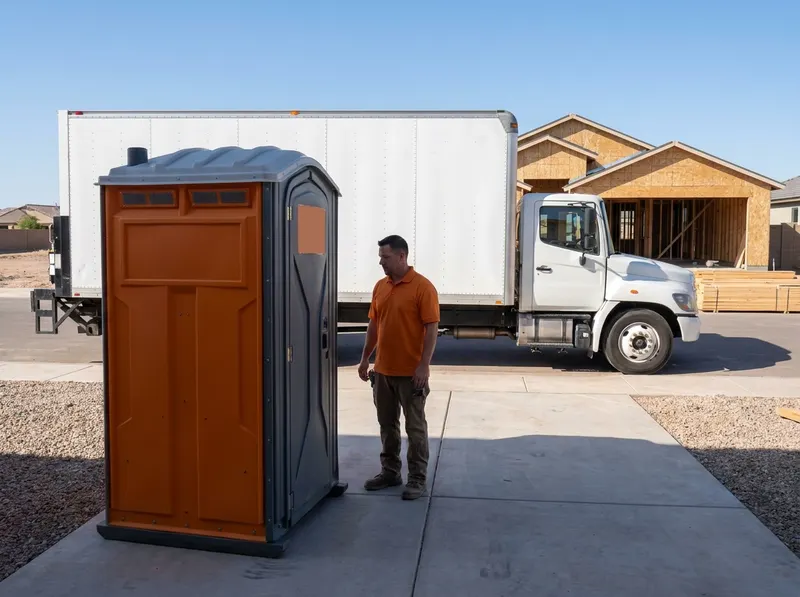
- What's included: standard construction unit, toilet paper, hand sanitizer, and scheduled pump-out and restock at an agreed frequency.
- How fast: most Buckeye job-site drops are scheduled within 24 to 48 hours; confirm the exact window when you call.
- What it costs: monthly rental for a standard construction unit runs roughly $250 to $400 per unit, with a $250 minimum charge on any order.
- What we handle: delivery, placement for your actual site layout, weekly (or more frequent) servicing, and pickup at project close.
- How to book: call (623) 235-0532 with your site address, unit count, and job length for a quote confirmed on a free site check.
Buckeye subdivision and warehouse builds run hard through the summer, and a un-serviced unit in 110°F-plus heat becomes the number-one complaint on site fast. This service commits the cleaning schedule in writing up front — weekly servicing on most standard construction rentals, bumped to twice weekly on high-headcount sites — so the unit stays usable instead of turning into a problem your crews route around. Servicing means a full pump-out, tank charge, restock of paper and sanitizer, and a wipe-down, not a quick glance from the truck.
Placement matters more on a construction site than anywhere else. Units get set on firm, level ground clear of the crane radius and delivery lanes, near the trades who use them most, and reachable by the service truck without a heavy tow through soft fill. On active grading jobs in Tartesso, Festival Foothills, and the newer Verrado and Sundance phases, that often means staging the unit near the site entrance early, then relocating it as the pad work moves — say the word and it gets moved. For scattered lot work across Blue Horizons, Watson Estates, Rancho Vista, and Sienna Hills, one unit covering multiple adjacent lots usually pencils out better than one per lot.
Standard construction units fit most trades work: framing, concrete, roofing, and finish crews on residential subdivisions and the warehouse and distribution shells going up along the I-10 corridor. Step up to a larger crew count and you add units on the OSHA-style ratio rather than overload one — plan roughly one unit per 10 workers per 40-hour week as a starting point, then adjust. If your job needs a hand-wash station or a flushing/ADA unit for an occupied-site or public-facing phase, those are separate line items; the standard job-site unit here covers the everyday trades work.
Rental length drives the number, not gimmick pricing. Short jobs — a two-week concrete pour or a punch-list stretch — bill differently than a nine-month subdivision run, and the servicing frequency is set to the site, not a one-size default. Every Buckeye order carries a $250 minimum. The quote you get is the quote that holds; the exact figure is confirmed on a free site check so placement and access are sorted before the first drop, not renegotiated after.
How much does it cost in Buckeye?
Every job gets a firm, written price after a free on-site visit.
Common questions
How often are construction units serviced on a Buckeye job site?
Will a porta potty stay usable in Buckeye summer heat?
How fast can you deliver to a job site in Verrado or Tartesso?
How many units does my Buckeye construction site need?
What does construction porta potty rental cost in Buckeye?
Ready to get started?
Tell us about your construction job-site porta potty rental job in Buckeye and we'll send a clear, written quote — usually the same day.